[PS]
All work
Design Tooling / SaaS

Product Studio

AI-powered UX design for teams that ship.

Next.jsTypeScriptCheerio (HTML parsing)Anthropic / OpenAI / Gemini APIsOllama (local fallback)

Project brief

The product bet, stated plainly.

Built an AI product studio that moves from brief to blueprint, deterministic UX audit, and exportable artifacts in one guided workflow.

Hiring signal

Senior ownership across product framing, execution scope, and shipped interface quality.

Engineering read

Focus on constraints, architecture bets, external systems, and data-flow decisions.

Role
Product architecture, AI workflow design, design-system modeling, and UX audit implementation
Scope
Provider setup, brief capture, blueprint generation, theme tokens, audit scoring, and export artifacts
Core constraint
Generated output needed measurable quality checks instead of relying on model confidence or visual plausibility.
Technical bet
Pairing generative agents with deterministic HTML audits would make AI page output more shippable.
Drag to scrub
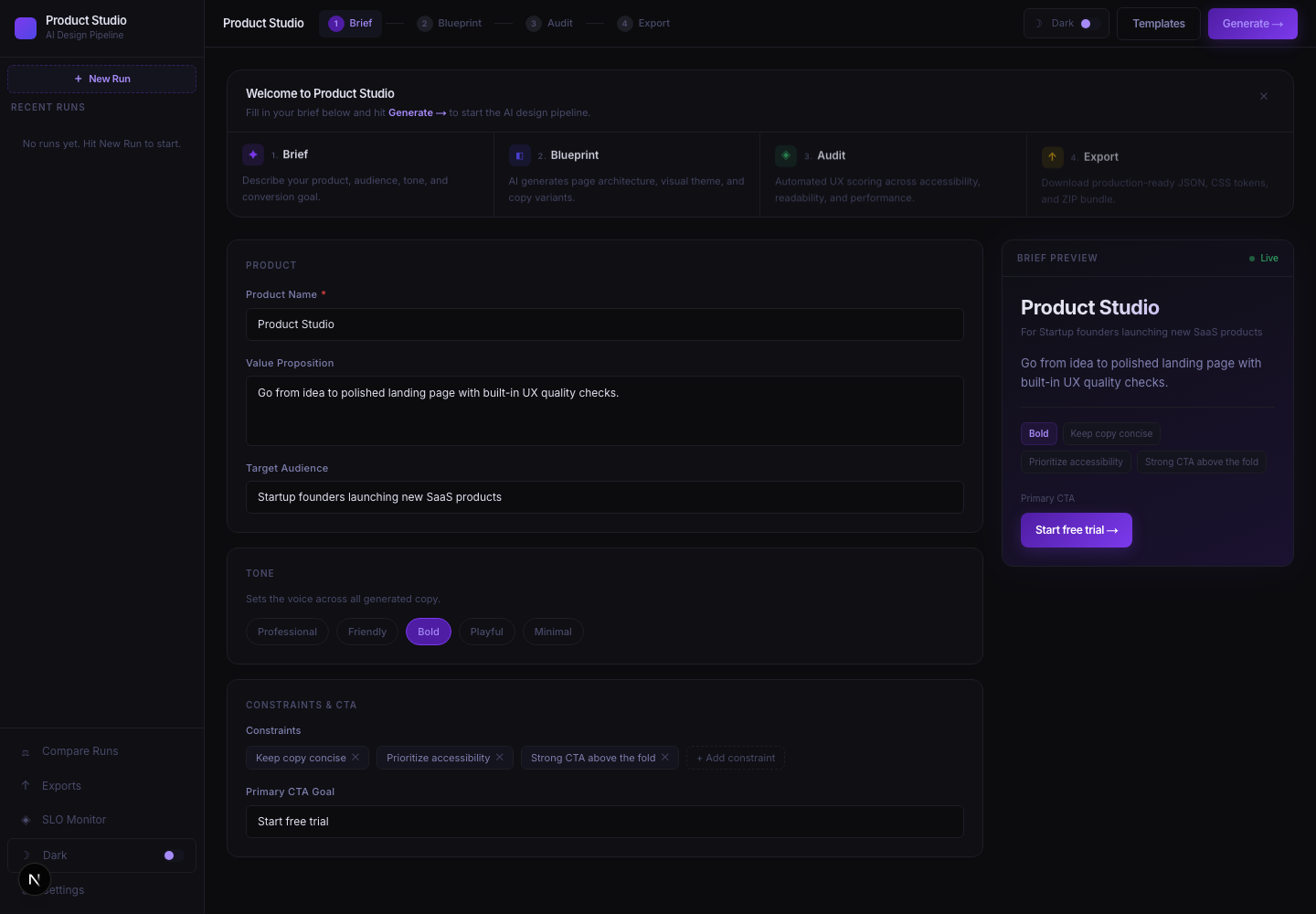
Ollama model selection flow
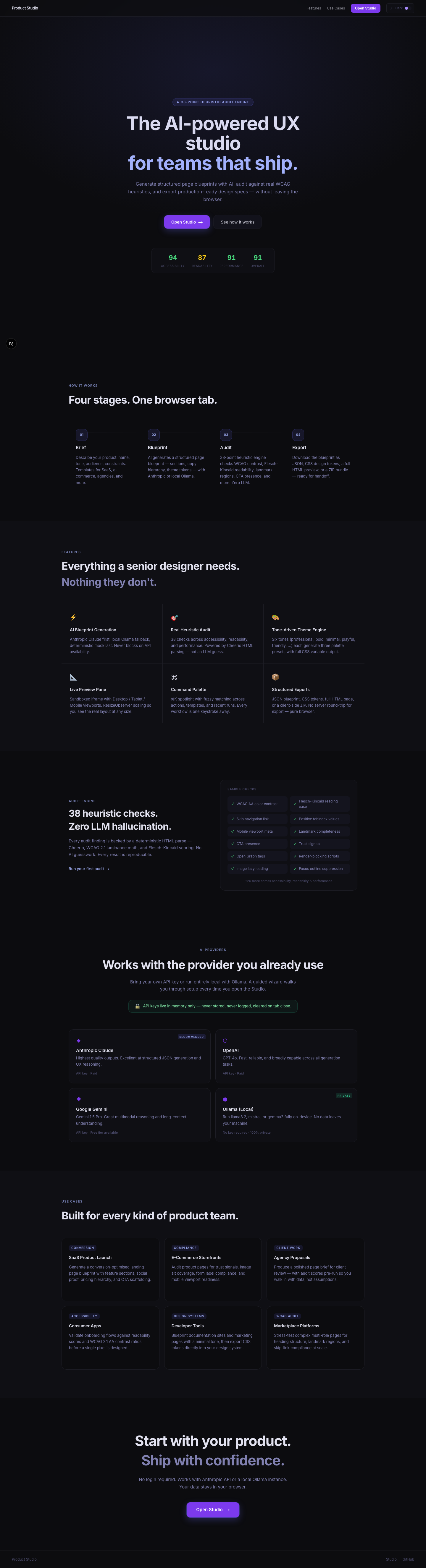
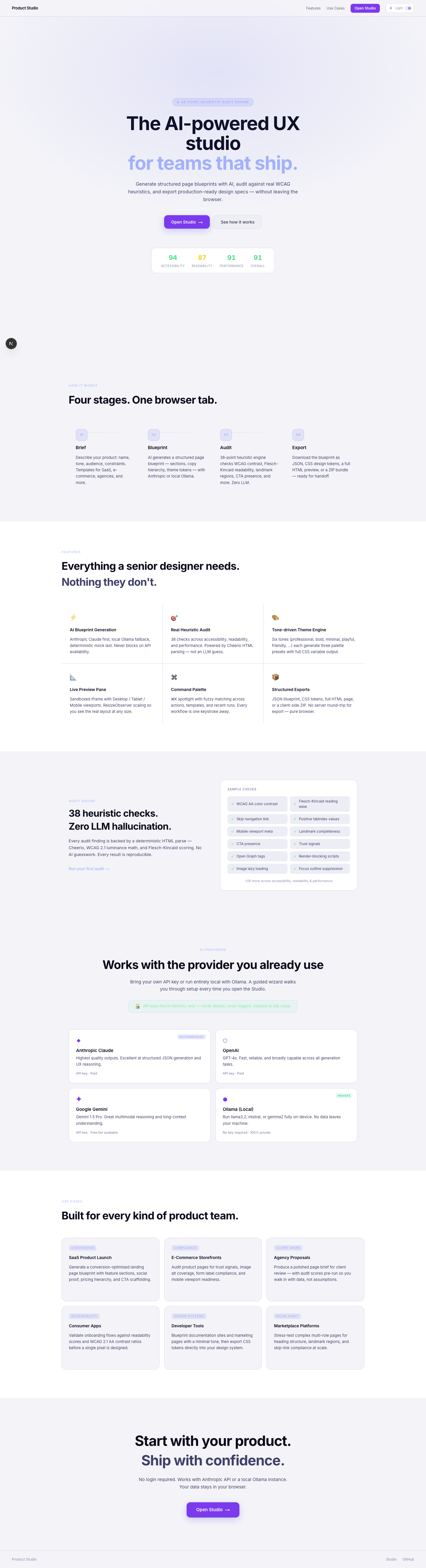
Product Studio root landing page in light mode
Landing page — light mode
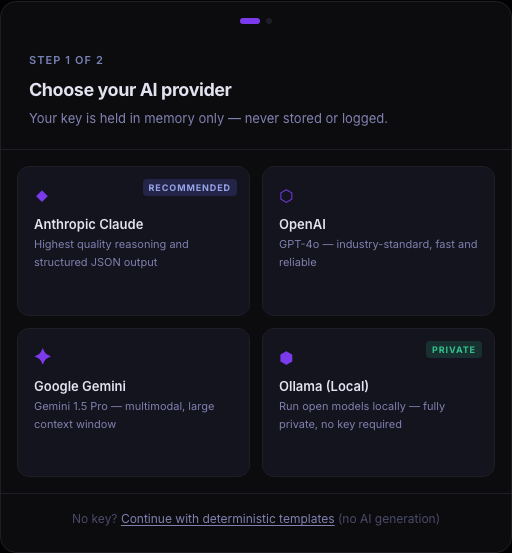
Product Studio AI provider setup modal in dark mode
Provider setup modal
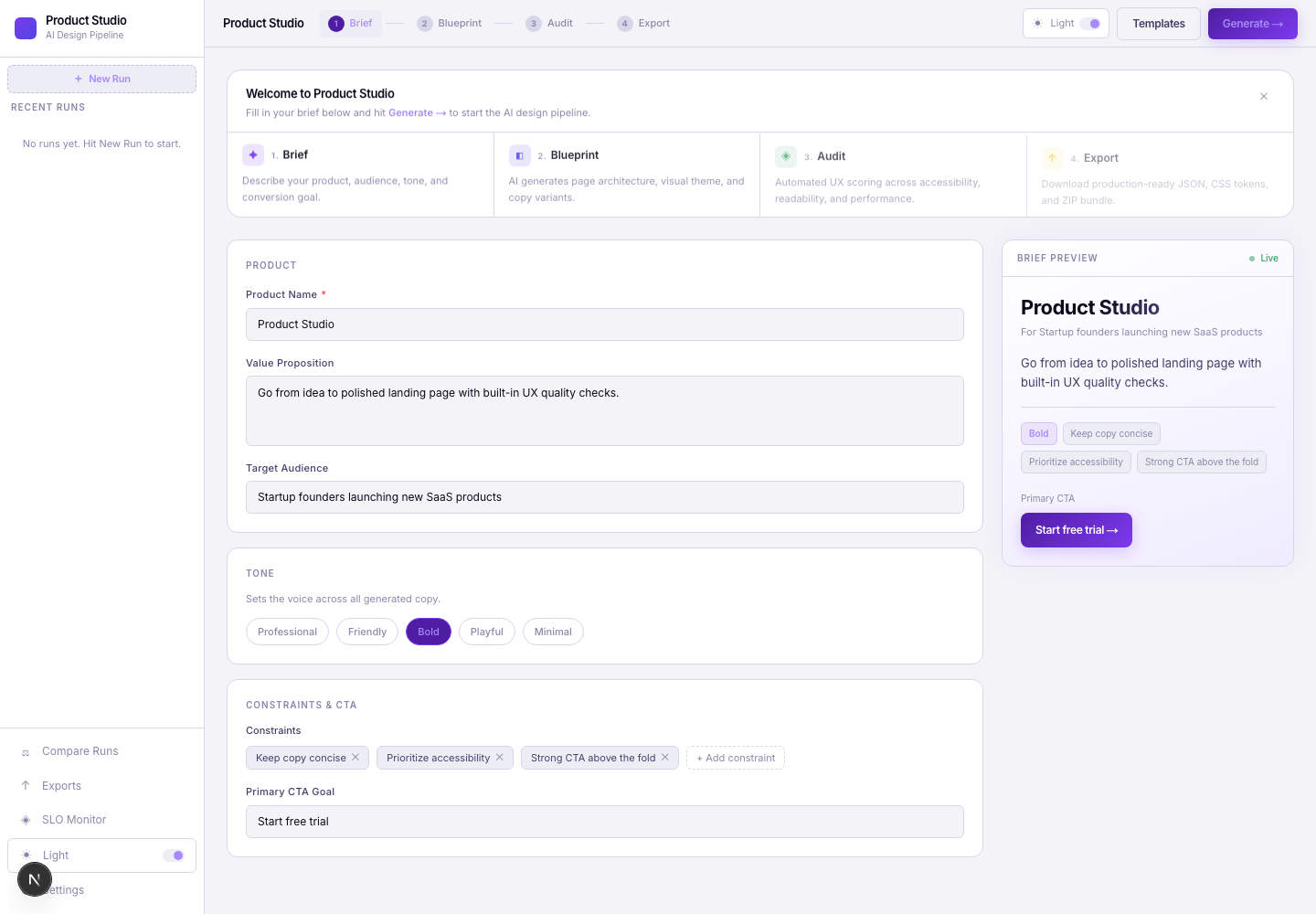
Product Studio workspace after Ollama setup in light mode
Studio workspace — light mode
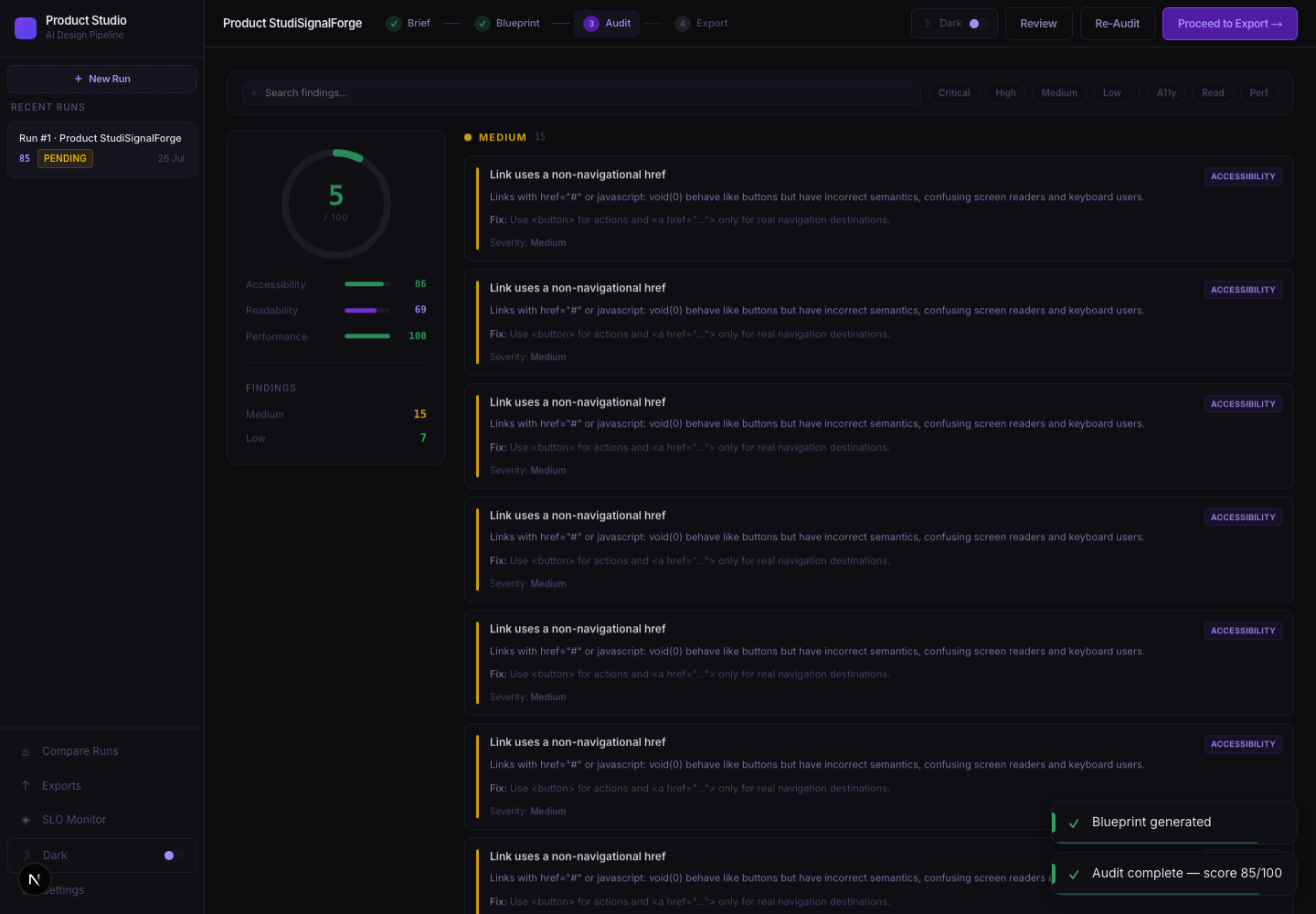
Product Studio audit results page in dark mode
Audit results — dark mode
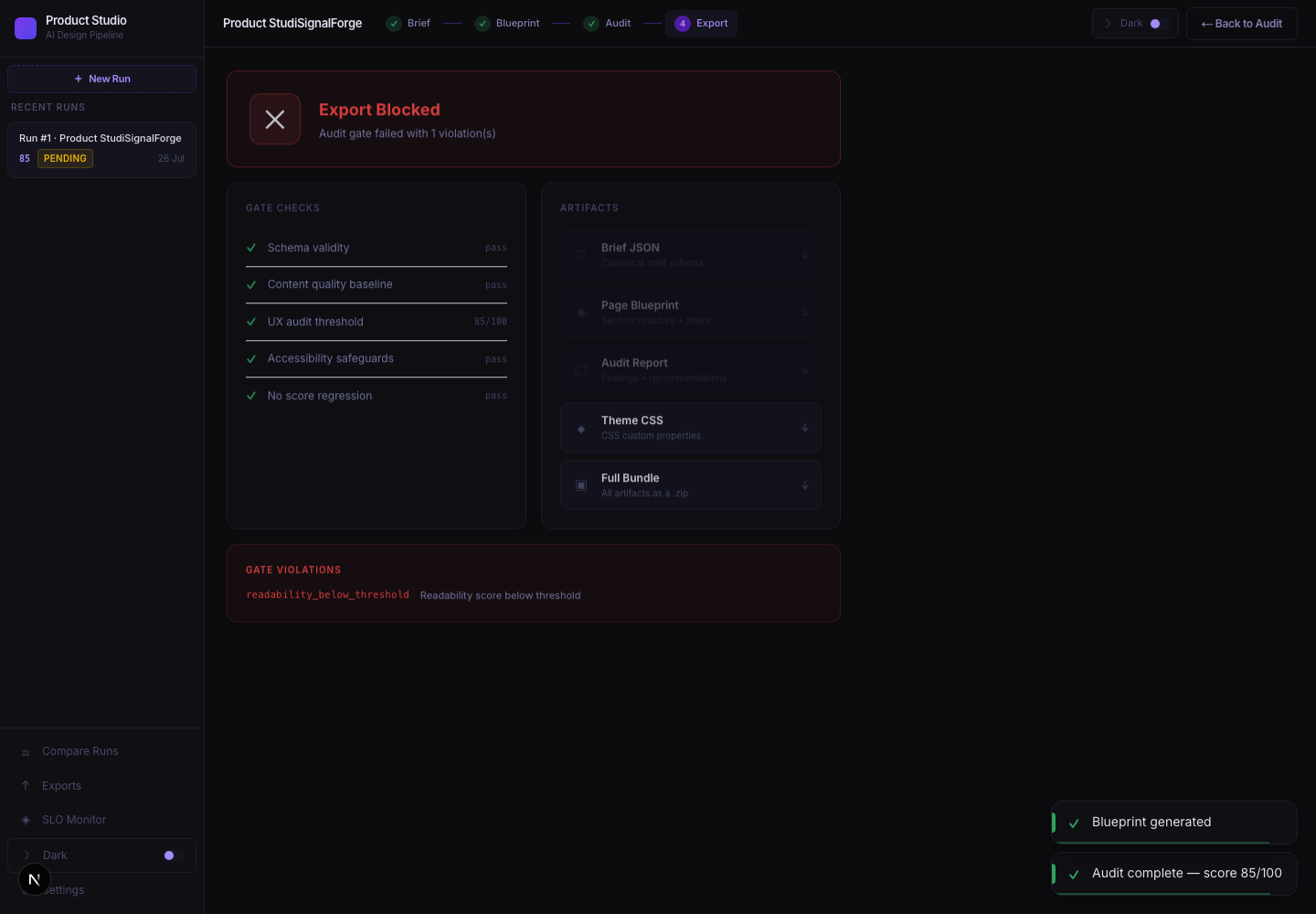
Product Studio final export page in dark mode showing gate checks and export artifacts
Final export — dark mode
Product Studio root landing page in dark mode
New run brief generation — light mode
Product Studio workspace after Ollama setup in dark mode
Studio workspace — dark mode
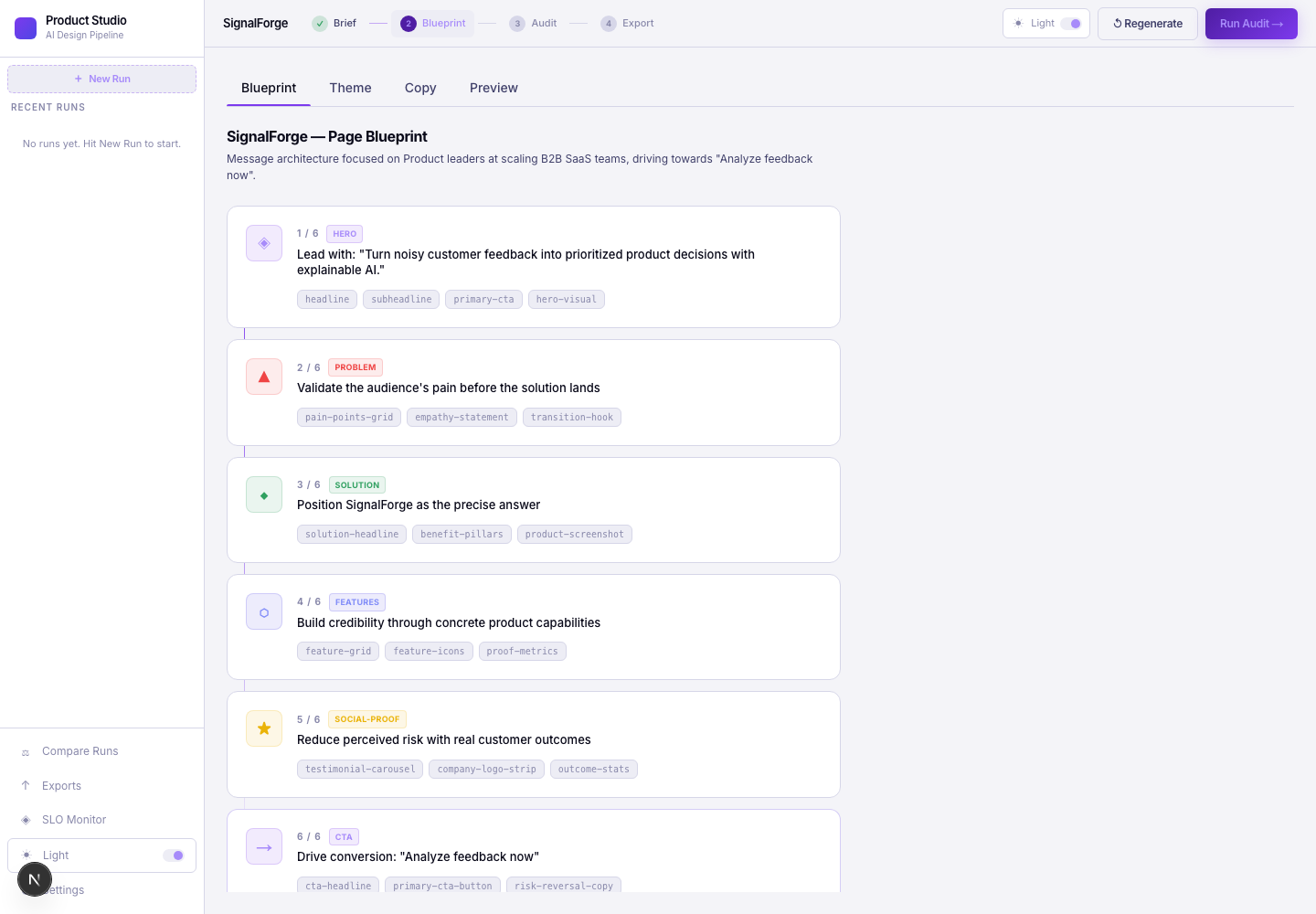
Product Studio generated blueprint view in light mode
Generated blueprint — light mode
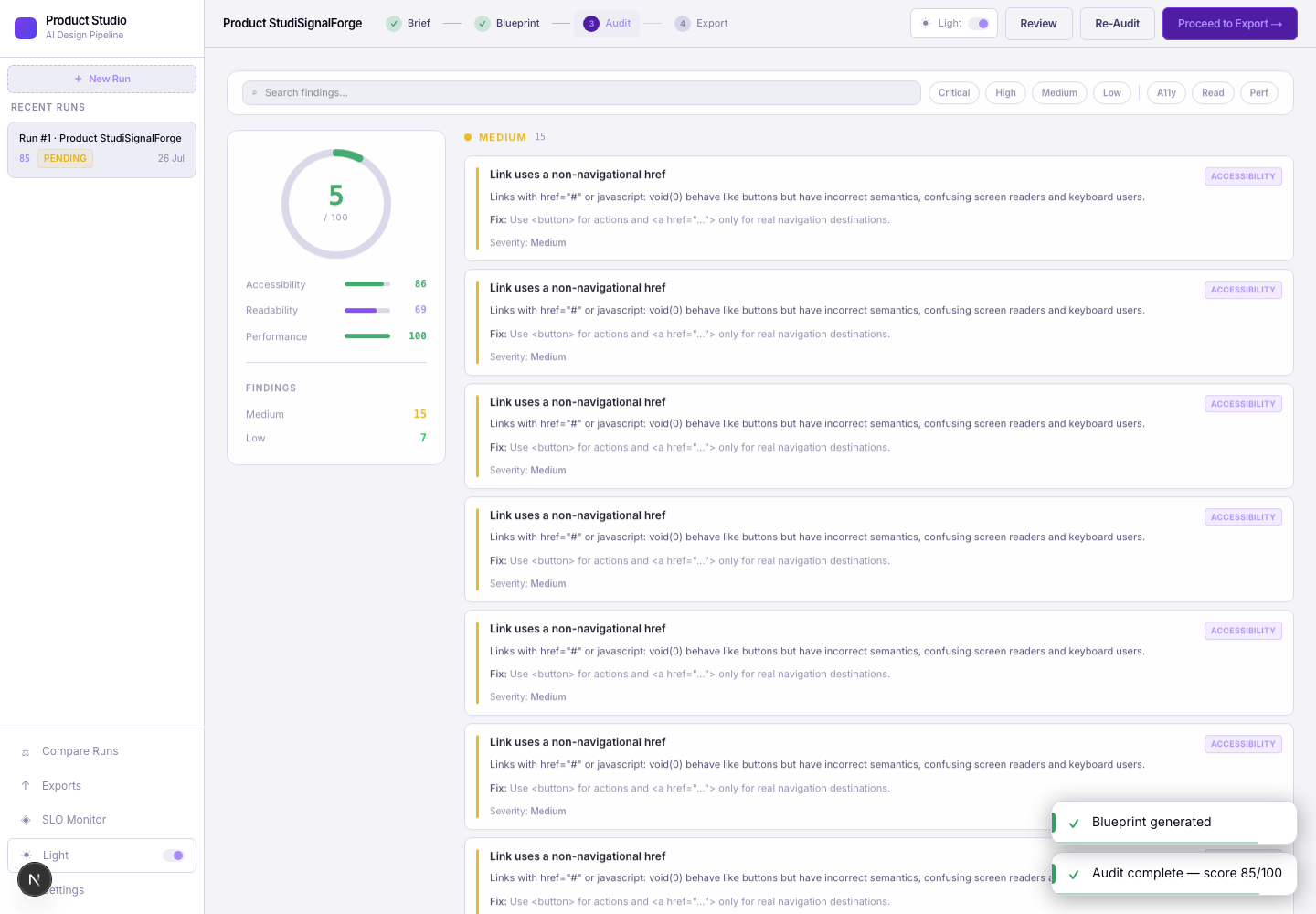
Product Studio audit results page in light mode
Audit results — light mode
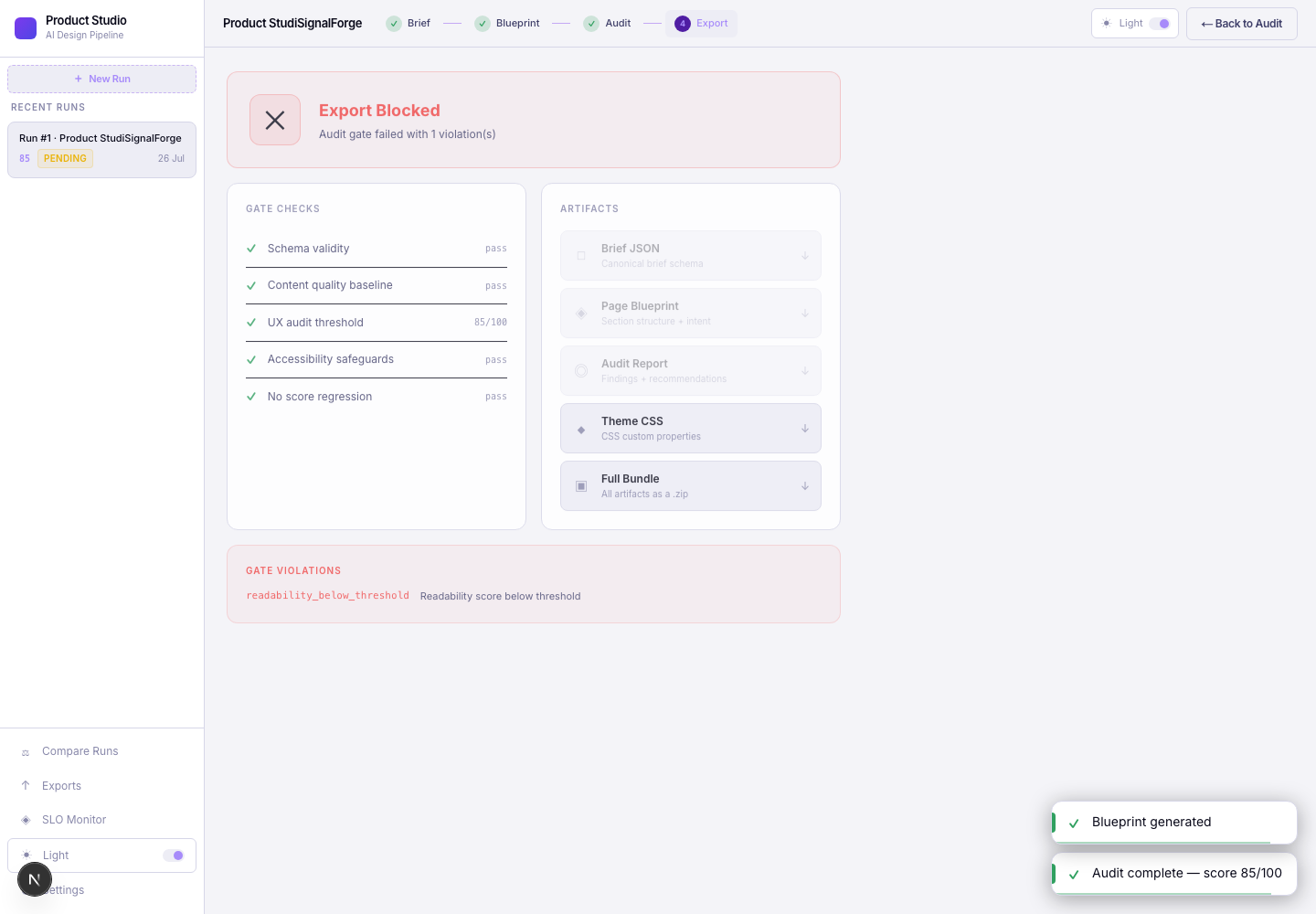
Product Studio final export page in light mode showing gate checks and export artifacts
Final export — light mode

Overview

A browser-based UX studio: generate structured page blueprints with AI, audit them against real WCAG and readability heuristics, and export production-ready design specs — without leaving the tab.

Problem

AI page generators are good at producing something that looks plausible and bad at proving it's usable. Teams end up shipping AI-generated layouts with no accessibility or readability guarantees, and no deterministic way to check them.

Approach

I split the product into a generative half and a verification half on purpose. Blueprint generation uses Anthropic Claude first, with an Ollama fallback and a deterministic mock so the tool never blocks on API availability. The audit engine is intentionally not an LLM — it's a 38-check pass over the real HTML using Cheerio, WCAG 2.1 luminance math, and Flesch-Kincaid scoring, so every finding is reproducible.

Project method

Detailed process

Requirements

The requirement was to reduce idea-to-page time without accepting the usual weakness of AI page generators: plausible output with no proof of quality. The workflow therefore had to capture a brief, produce a structured blueprint, generate theme tokens, audit the result deterministically, and export usable artifacts.

Stack choices

The app became a Next.js monorepo so the studio UI, agent runtime, theme engine, UX audit package, and shared schemas could evolve independently. Provider calls were abstracted behind Anthropic, OpenAI/Gemini, and Ollama fallbacks, while Cheerio and the audit package handled HTML inspection without relying on model judgment.

Design system

The UI follows Brad Frost's atomic design: atoms, molecules, organisms, and templates with imports flowing downward. The visual system uses Product Studio tokens such as ps-canvas, ps-surface, ps-raised, ps-border, ps-accent, ps-ink, and severity colors, which made the studio feel like a coherent workbench rather than a collection of generated panels.

MVP definition

The MVP was the four-stage path from brief to blueprint, audit, and export. Multi-page generation, CMS integration, collaboration, and analytics were explicitly kept out so the first version could prove the core promise: generated page structure plus measurable UX quality.

Progression

Development started with canonical schemas for Brief, PageBlueprint, ThemeTokens, AuditReport, and FixPlan. The UI then layered in review checkpoints, run history, command palette actions, preview viewports, and export formats once those contracts were stable enough to keep the generated artifacts predictable.
Conclusion

Solution

Four stages — brief, blueprint, audit, export — take a product description to a scored, exportable page spec. A command palette (⌘K) keeps every action a keystroke away, and exports (JSON, CSS tokens, full HTML, or a client-side ZIP) require no server round-trip.

Proof list

Highlights

04 signals
  • 0138-point deterministic heuristic audit engine, independent of any LLM
  • 02Three-provider AI fallback chain (Claude → OpenAI/Gemini → Ollama) so generation never hard-fails
  • 03Live sandboxed preview pane with desktop / tablet / mobile viewports
  • 04Fully client-side export pipeline — no server round-trip on download

Product screenshots

Open channel

Need a sharper frontend path?

Architecture, AI workflows, design systems, and interfaces that need to hold up after launch.